
CSIRO has finalised the inaugural version of The CSIRO Book, a publication aimed at clarifying the organisation’s research efforts and a key component of Executive’s strategy, alongside the Enterprise Services restructure and Property and Infrastructure sustainability.
The CSIRO Book is a public facing offering that seeks to communicate ‘what we do, how and why we do it, and the impact we deliver,’ and is anticipated to be regularly updated and sit alongside key documents including the Annual Report and Corporate Plan.
“For science to have impact it must be trusted, and a key foundation of trust is transparency… this book shines a light on what we are doing, and how and why we are doing it. It describes the full range of our research portfolio, including how we are approaching the work, our collaborators and the reasons the research matters for Australia,” CSIRO Chief Executive Doug Hilton said.
While the Enterprise Services restructure has resulted in close to five hundred job losses – the largest CSIRO cuts in more than a decade – Dr Hilton announced a temporary pause until July 2025 on further cuts to research positions.
However, there is widespread speculation that a new round of job cuts will soon impact scientific roles in coming months.
The publication of The CSIRO Book represents the culmination of an eighteen-month process to achieve, in the words of Dr Hilton, a “shift towards a more holistic approach to managing our research portfolio.” This included the development of Programs of Research (described earlier as Programs on a Page), a Research Portfolio Workshop and working group, leading to the evolution of The Book.
The Book is conceived as somewhat of a living document. “The Book is not carved in stone, it will change as our national priorities shift and as our science advances,” Dr Hilton said.
“We expect our programs of research to evolve continuously as technology changes, as our work succeeds and we unlock new solutions, as new partners join us, and as new challenges and questions need answers. Therefore, to keep The Book current, we will issue a new edition on a regular basis.”
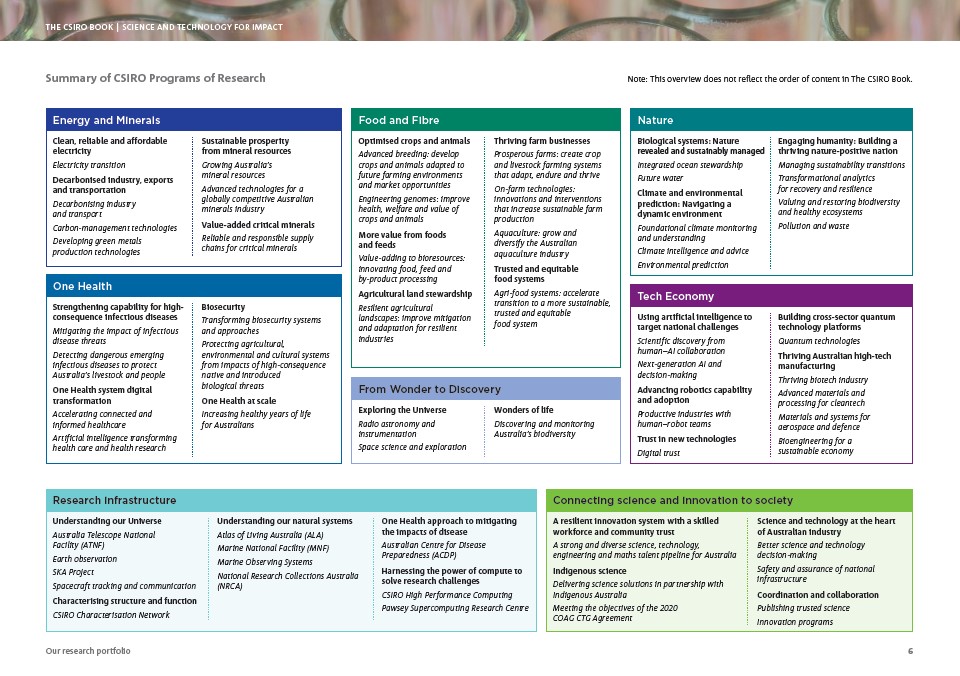
The first and most substantial section of the book covers CSIRO’s research, divided into Programs of Research, rather than the organisation’s research unit structure. These Programs of Research are listed as Energy and Minerals, Food and Fibre, From Wonder to Discovery, Nature, One Health and Tech Economy.
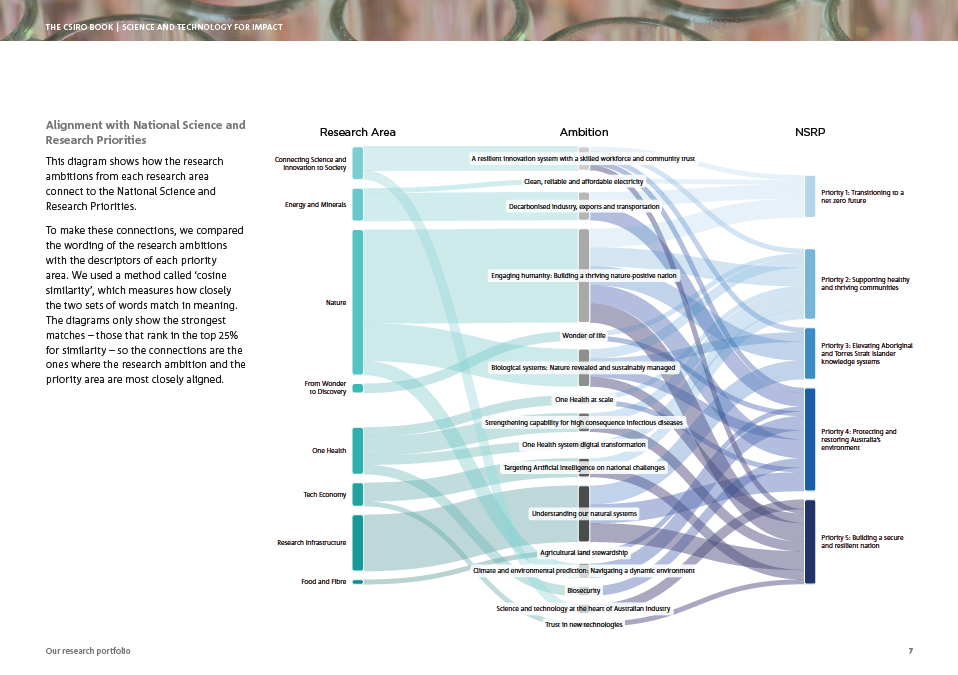
Those programs are then mapped and charted by goal or ambition to demonstrate alignment with the Federal Government’s National Science and Research Priorities and the Future Made in Australia priority sectors.
The document also sets out common themes that span the research portfolio, similar to the delineations marked out by the now defunct Future Science Platforms and Missions.
The second section showcases CSIRO Research Infrastructure and the International and National Facilities hosted by the organisation.
‘CSIRO develops and manages research infrastructure both for our own research portfolio and on behalf of the nation, ensuring that it remains sustainable, safe and fit for purpose. This infrastructure connects a broad network of scientists, government and industry partners, and communities, fostering collaboration and accelerating innovation.’

This consists the five facilities that attract National Collaborative Research Infrastructure Strategy (NCRIS) funding; the Atlas of Living Australia (ALA), Australian Centre for Disease Preparedness (ACDP), Australia Telescope National Facility (ATNF), Marine National Facility (MNF) and Pawsey Supercomputing Research Centre (Pawsey) as well as earth observation assets and the Square Kilometre Array Observatory (SKAO).
The final section is titled ‘Connecting science and innovation to society’ and covers the ways the organisation aims to collaborate and coordinate.
‘CSIRO aims to inspire, support and drive a shift to a knowledge‑intensive economy that mobilises science, technology, creativity and entrepreneurship to fulfil national aspirations in a globally connected world. In addition to delivering great science and national scale research infrastructure, CSIRO will play a key role in supporting and strengthening the innovation system.’

This includes engagement with Indigenous science, industry, communities, building STEM capacity in the Australian workforce and improving the level of evidence-based policymaking.
According to Dr Hilton, one of the key purposes of The Book “is to report back on what we and our collaborators achieve and to reflect on our impact to evolve our portfolio. There are many important and compelling demands on public spending in Australia and CSIRO must repay the community’s trust and investment in our work.”
Next up, CSIRO will undertake a Research Portfolio Build Workshop, which aims to bring ‘together our senior leaders to focus on our future-facing Programs of Research… (building) on our current state description (of PoRs) and providing a forum to collectively understand and shape CSIRO’s future research portfolio.
Scheduled to be held over four days in early September, the workshop ‘will be attended by members of the CSIRO Leadership Team, Science Directors, Deputy Research Unit Directors, and Research Program Directors’ and provide a forum to collectively understand and shape CSIRO’s future research portfolio.”