
The initial results from CSIRO’s Culture and Engagement survey are in and the report reveals another set of terrible ratings, showing minimal to no improvement on last year’s returns.
Deputy Chief Executive Elanor Huntington acknowledged the ongoing impact of job cuts on CSIRO morale.
“We know this year has brought significant change, and for some teams it has been especially challenging. That reality is reflected in some of the feedback you’ve provided,” Dr Huntington said.
Overall, an abysmal set of results for CSIRO, with the ongoing workforce trauma of successive rounds of deep job cuts writ large.
Staff confidence in the organisation’s strategic direction has completely eroded and senior leaders are being held up for blame.
These very poor ratings underscore the scale of the challenge facing Executive to rebuild trust with CSIRO employees.
A year ago, we reported on “a snapshot of a workforce struggling with low morale, lacking confidence in the organisation’s strategic direction and still reeling from the impact of hundreds of job cuts to support roles. That sentiment is unlikely to improve in the near future, with the widespread expectation of further job losses, this time to research positions.”
Not much. Last year’s low ratings have stayed low or fallen further. Executive’s commentary characterises this as ‘stability’.
Any improvements have been slight, probably most notably in terms of the perception of staff in their own individual abilities to remain resilient amid these significant restructures.
One bright spot is an overall favourability rating for line mangers of 77 per cent, up seven points from last year.
This is the second exercise using software provided by Australian startup Culture Amp, effectively bringing the survey process in house (rather than using an external provider such as Denison or Willis Towers Watson).
There are new sections and questions covering organisational enablement, role enablement, innovation, employee commitment and security.
While the report describes the overall participation of 67 per cent as ‘stable’ (up one point from last year), that’s still barely two-thirds.
Research Unit participation was significantly lower (64) when compared to Enterprise Services (78).
CSIRO was able to achieve clear majority approval (more than two-thirds) for Security (new, 95), Safety (88), Direct line manager (77), Psychological Safety (69) and Role enablement (68).
The ratings then slide for Employee engagement (new, 64), Organisational engagement (new, 60) and fall further away for Unit leaders (58), Innovation (new, 57), CSIRO Values (55), Employee commitment (new, 55) and collaboration (52).
Poorest returns were recorded for Change (46), Strategic Direction (43) and Senior Leaders, Executive and Unit Directors, worst of all (36).
Employee Engagement scored 64 per cent favourable, a five-point drop from last year’s measure (69).
The steepest decline of engagement ratings was employed in Research Units which overall slid nine points to 61 per cent in the past twelve months.
‘These drops indicate that uncertainty, changed priorities, and evolving ways of working are affecting how research staff feel about their connection to CSIRO and their future within it,’ the report states.
No two ways about it, staff confidence in the strategic direction is atrocious, with an overall positive rating of 43 per cent, down 19 points from last year’s result (62). That vertiginous fall may be explained by the addition additional questions that scored badly (more on that soon) but it’s still a miserable result.
Put another way, more than half of CSIRO staff (57 per cent) are unsure or are not in favour of the agency’s strategic direction. However, more than two thirds of participants (70) think their work continues to contribute to the organisation’s goals.
Only 26 per cent of respondents believe that Executive effectively directs resources towards the organisation’s goals, while barely a quarter of staff (26) think that CSIRO is well positioned for success over the next three years.
That’s a particularly poor result when considering employee confidence in Executive’s capability to manage the extra $620 million in additional funding provided by the federal government for CSIRO sustainability.

Some 83 per cent of staff reported possessing a good understanding of CSIRO values and likely identify. But that’s where the good news ends.
Less than half (49) believe that the values match up with day-to-day realities at CSIRO and confidence in any organisational accountability is abysmal (24).

Support for flexible work arrangements (86) and satisfaction with physical workplaces at CSIRO (68) gets a thumbs up, and more than two-thirds (68) of respondents are confident that co-workers do what they say and follow through on those commitments.
However, less than half (40) agree that CSIRO processes and system support effective task completion and even fewer (36) believe that the right people are rewarded and recognised.
Just over two-thirds of participants reported feeling enabled in their roles. At the upper end, this included having sufficient autonomy to perform effectively (82) and an understanding of the components of success (80).
This falls away when it comes to access to learning and development (69), necessary resources to work well (65), readily available information (62), reasonable workloads (62) and appropriate involvement in decision making (61).
The results for Executive and Unit Directors are, in a word, horrendous.
The ratings for senior CSIRO leaders providing motivating vision (31), accountable performance (28) and necessary decision making for future success (38) are particularly parlous.

Unit leadership (not including directors) fare slightly better, with a basic majority of respondents rating the translation of strategic objectives into local actions (59) and supporting collaboration across units (58).
Line managers remain the real heroes, recording more than three-quarter approval across seven separate questions, with an overall favourability rating of 77 per cent, up seven points from last year.

Collaboration ratings are going backwards, down two points from last year to 52 per cent. Merely half of survey participants (50) report recognition for efforts to work across boundaries, and only 54 per cent can identify effective collaboration across CSIRO siloes as an often occurrence.
The ongoing impact of heavy job cuts continues to wreak havoc. Less than one-third (31) of respondents agree that CSIRO has the systems and processes to manage change effectively and only slightly more participants (36) believe the organisation has the collective mentality to adapt.

Just over half of respondents believes that CSIRO acts on promising, new or innovative ideas (55), while slightly more agree that staff are encouraged to innovate even if efforts fail to succeed (58).
Only 58 per cent of participants think that the organisation has the capacity to learn from errors and improve work practices.
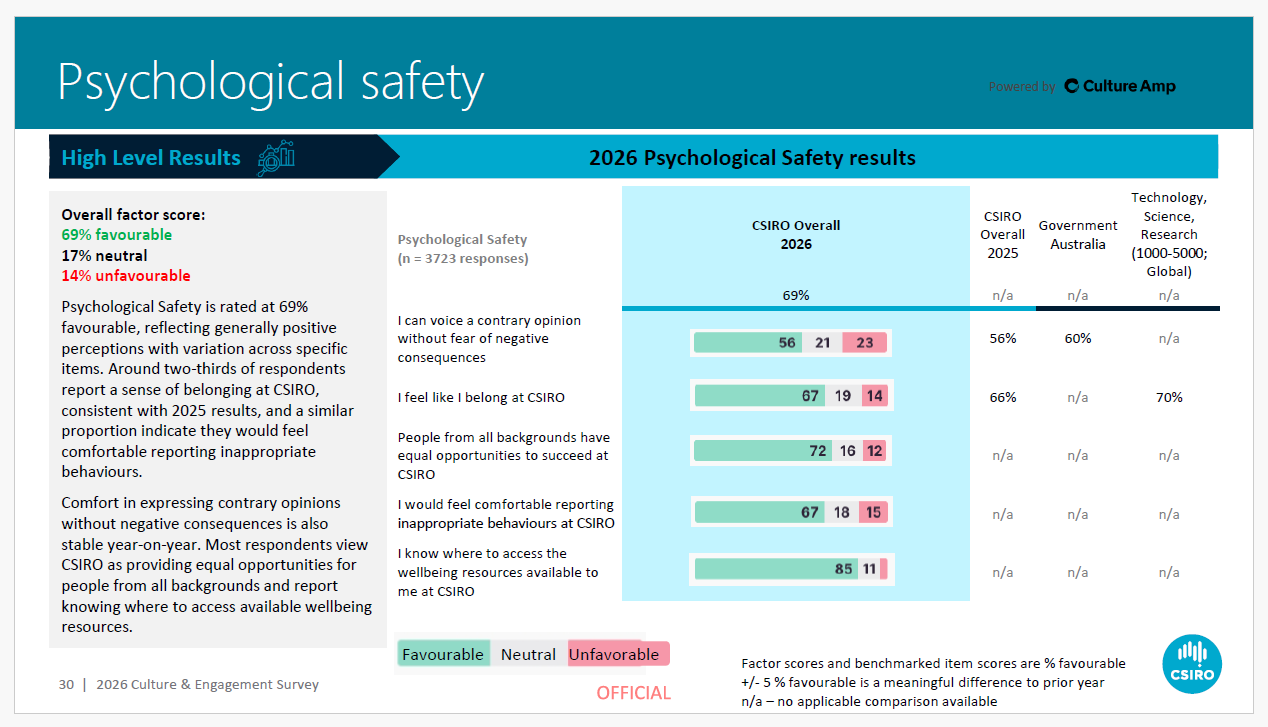
There continues to be a significant, 19-point gap between the perception of physical (88) and psychological (69) safety at CSIRO.
While more than two-thirds of respondents believe that CSIRO is personally inclusive (67), provides equal opportunity to succeed, regardless of background (72), only 56 per cent of participants agree that contrary opinions can be voiced without the fear of negative consequences.
New questions revealed an overwhelming majority of respondents feeling confident in recognising security issues (95) and understanding of the individual responsibility (96) in maintaining a secure work environment at CSIRO.